GTA 6 Developer Notes: How Rockstar Built Leonida
Fewer mission fails, 600,000 NPC animations and a world designed building by building — what Rockstar's developers said.
Rockstar's developer notes explain how GTA 6 was built: open-ended missions that punish experimenting less, around 600,000 NPC animations, and a Leonida designed building by building.
Read the sources and uncertainty notes below. Our sourcing policy · Request a correction
Table of Contents
- 1.What did Rockstar say about how GTA 6 was made?
- 2.Missions: fewer fails for trying something different
- 3.The world: designed building by building
- 4.NPCs and animation: 600,000 animations for a living world
- 5.The interface: GTA's DNA, only quieter
- 6.The story and the quiet moments
- 7.Customization: shops that reflect their neighbourhood
- 8.Who said what
- 9.What the GTA 6 developer notes do not say
- 10.FAQ
- 11.Did Rockstar really cut mission fails in GTA 6?
- 12.How many animations does GTA 6 have?
- 13.Who are the developers behind these notes?
- 14.Does the open-ended mission design mean I can ignore objectives?
- 15.Sources
What did Rockstar say about how GTA 6 was made?
Since launch, Rockstar has been sending TechRadar Gaming a series of GTA 6 developer notes — on-the-record comments from the leads across its departments, explaining how Grand Theft Auto 6 was actually built. The notes were supplied to press reviewing the game in advance and published in instalments between 19 and 26 November 2026. Two instalments already have their own pages here: the new sound system and the rewritten vehicle physics. This is the rest of the series — missions, the world, NPCs, animation, the interface, the story and customization — in one place.
The short version: Rockstar cut back on mission fails so experimenting is not punished, built around 600,000 NPC animations so the streets feel inhabited, designed Leonida building by building with a named resident in mind for each one, and kept the classic GTA interface — Pricedown font, minimap, wanted stars, Wasted screen — while making it quieter. Rockstar founder Sam Houser frames the whole project in the notes' foreword: "We strived to create an experience that exceeds your expectations, showing just how much the medium of gaming can express and what makes this game special." He adds that the player is ultimately the one who decides how the story feels — and how it concludes.
Missions: fewer fails for trying something different
The headline change for anyone who has ever restarted a mission for going off-script is the mission design. David Hynd, vice president of technology, says: "We wanted to minimize situations where a player fails a mission simply because they tried something new or played in an unconventional way." The team, he says, "embraced more of an open-ended design philosophy on this project" — not only for missions, but for all content types.
That is a deliberate break from how Rockstar missions used to work, where straying from the scripted route often meant a fail screen. To make it work, Hynd says Rockstar "leveraged a lot more of our regular mechanics/AI and systems within Missions to better support the many different ways a player can approach a particular bit of content" — so the rules you learn wandering Vice City are the same rules that apply inside a mission, and improvising mid-chase is treated as a valid input rather than an error. He is honest that it was harder to build: "It's a lot harder to keep Missions as open as possible (especially in a game as large as this), but the freedom and flexibility it allows the player was worth it."
Vice president of design Stephen Donkin says the goal was to blur the line between being "on-mission" and "off-mission" as much as possible, so that even when several types of content are running at once, they feel like natural events in the world rather than sharply distinct activities. Roaming the open world with your partner opened up a new way to do that: dialogue can now happen outside formal missions, connecting free-roam play to the story. Lead design director for missions and visualization Luke Howard adds that the team took care to make sure player agency never clashed with what Jason and Lucia would actually do.
What this does not mean: missions have no fail states, no story gates and no character locks. Rockstar reduced the fails that punish experimentation; it did not remove consequences, and the notes name no difficulty option and no mission count. For the missions themselves, see our GTA 6 missions series.
The world: designed building by building
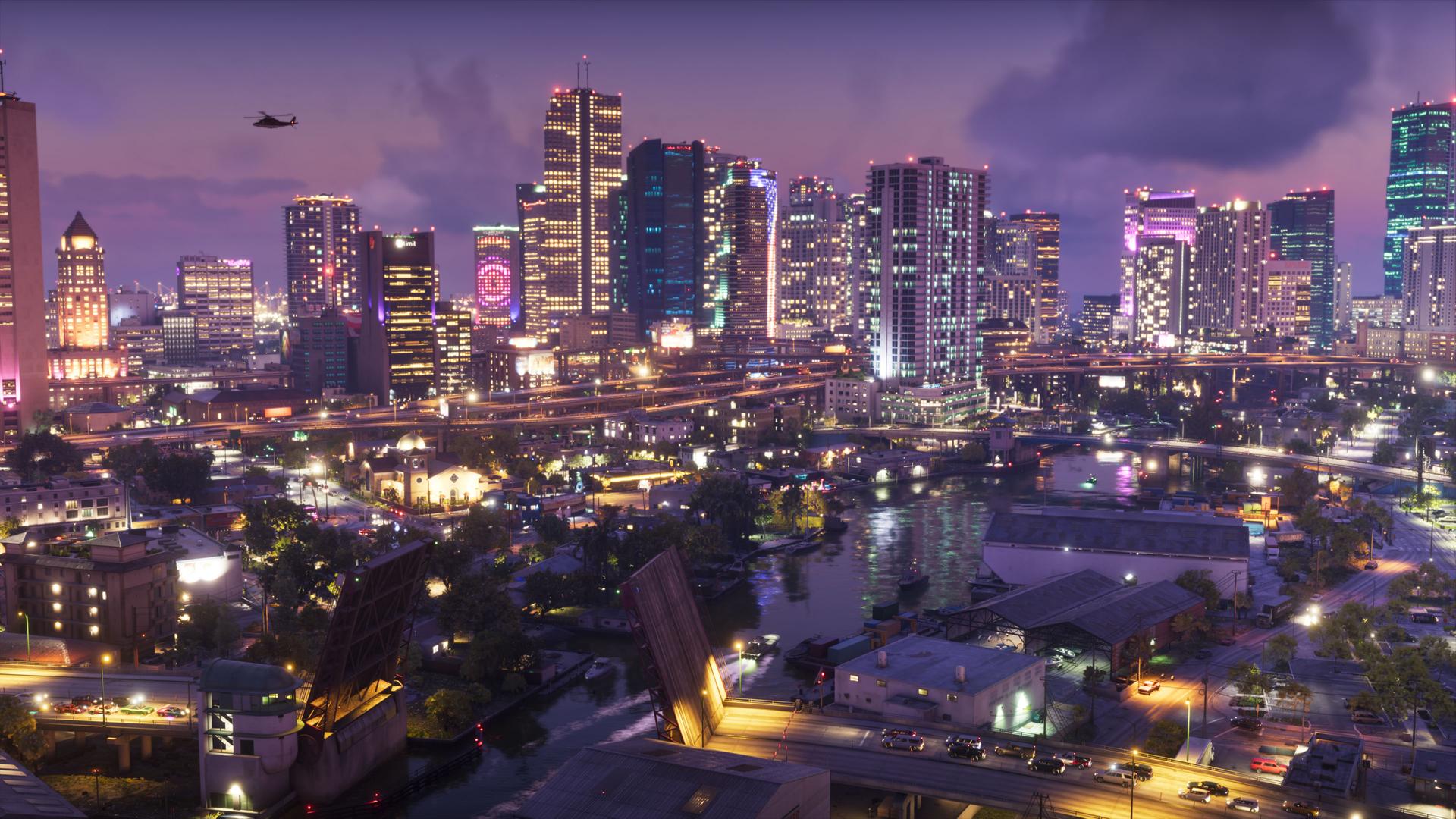
The world design notes are the clearest explanation of why Leonida feels hand-made rather than generated. Miriam Bellard, vice president of art for visual development, says that when designing a space she first imagines the kind of person who would live there — whether they hired an architect, decorated the home themselves, tried to show off their social status through the exterior, or prioritized comfort and practicality. She says she particularly enjoyed designing industrial facilities, run-down spots, luxurious buildings and dangerous locations, each with its own distinct identity.
Adam Cochrane, vice president of art for environment, points to the small details that carry that identity: flags swaying in the wind, a puddle of bin juice around a dumpster, an overgrown garden at an abandoned house. Each home and business, he says, was given a unique personality to avoid repetition — some locations offer rewards, others contain subtle stories. John Macpherson, lead director of world and population design, says the team went on location scouting trips to Florida and spent time with residents, observing everything from their clothing and gait to their conversations and the music they played in their cars.
Donkin describes the hard part as making all of it interact: the environment, characters, vehicles, NPC dialogue, missions, soundtrack and in-game media all influence one another. His example: if police are searching for one criminal and a new crime happens right in front of them, the team had to decide what the police prioritize — and whether the original suspect tries to flee. At a certain point tuning those systems, he says, "it felt less like we were creating the game and more like we had entered a collaborative partnership with it." That same thinking is why Donkin hopes players stop treating Leonida as a checklist: "There is so much to do in Leonida, and so much to discover, that we hope players get to the point where they stop thinking in tasks, completion percentages, online guides and rather let the game unfold in front of them."
NPCs and animation: 600,000 animations for a living world
The numbers behind the crowds are the most quoted part of the notes. Edge reports that Rockstar art-directed every NPC, creating around 600,000 animations — roughly double Red Dead Redemption 2's 300,000 and about ten times GTA V's 55,000. Mark Tennant, vice president of animation, told TechRadar there are "close to a thousand animation sets for ambient activities, then we layer in hundreds of bespoke one-off events and custom sequences" — the daily routines of background characters, built so the world rewards players who explore it rather than rushing through it.
Valmor Garcia, lead technical art director for dynamic art, explains the aim: NPCs should never look like background scenery. Each one is distinguished by personality, mood, body type, face and dialogue, with visual quality designed to approach the standard of protagonists Jason and Lucia. "We feel we've consistently elevated the visual fidelity across the entire cast, including every world NPC," he says. The proprietary hair and cloth simulation and the face and body customization technology were applied across the whole world, not only to key characters — and a dedicated team in Los Angeles was set up to work on NPCs specifically.
Mike Jones, director of gameplay animation, says the team focused on combining responsive movement with a realistic sense of physical weight. Where Red Dead Redemption 2 had a deliberate, slower pace suited to its era, Jason and Lucia's world demanded faster movement and quicker interactions. The detail work went deep: Jones cites Lucia pushing open a door with her hip while holding a drink — "That took months to develop, but it's that important." Vaulting and climbing were built to maintain momentum over obstacles, fences and rooftops, with countless variations depending on how the player triggers the action. Tennant adds that a new workflow lets characters of different body types share animations naturally, and the physical interactions between Jason and Lucia were refined as their relationship developed.
The interface: GTA's DNA, only quieter
Stuart Petri, vice president of art for 2D/UI design, says that with roughly 25 years passing since Vice City's debut, the screen design had to evolve — but the team strove to preserve the iconic elements that make it GTA: the signature Pricedown font, the minimap, wanted stars and the Wasted screen. His rule for the HUD: "It needs to be there when you need it, but it shouldn't be a distraction." Information is a button press away; the goal is for it to recede from the screen when you are back to playing.
Sam Grosset, associate director of UI/UX design, says accessibility was integrated from the early planning stages. Players can tailor settings to their preferences — increasing font size, simplifying HUD displays, or changing sprint controls. He also notes that revamping the in-game phone interface into an in-hand device was a deliberate choice to enhance Jason and Lucia's perspectives. If the defaults do not suit you, our best PS5 settings guide walks through the options.
The story and the quiet moments
Rupert Humphries, senior vice president of narrative, says the emotional bond between Jason and Lucia is the central feeling he hopes players connect with. The writing team captured modern life under the pressures of politics, the environment, media and social media through Vice City's residents, weaving conspiracy theories, cults, scams and substance abuse into the narrative. "We wanted to convey the message that even for flawed people, it's better to face things together than alone," Humphries says.
Game writer Elizabeth Gauvey-Kern says the quiet moments mattered as much as the dramatic weight: sharing a morning coffee, taking long drives, lounging side-by-side in bed. Michael Wiafe says the writing team started by researching decades of Florida crime cases, but refused to tie characters strictly to real-world events — they are distinct criminals with relatable human qualities. Alex D'Agostino notes that because it is impossible to predict how long a player will interact with a supporting character, even brief lines of dialogue had to convey personality, motivation and individuality. Senior design director Ghyan Koehne adds that alongside the high-energy moments, the team hopes players find room for "quiet, meditative experiences" that evoke a sense of wonder.
Customization: shops that reflect their neighbourhood
David Vallance, lead costume and inventory artist, says merchandise in shops across different regions was meticulously curated so players can customize Jason and Lucia in their own style — each shop reflecting a distinct aesthetic, from vintage stores in Port Gellhorn to high-end boutiques in Vice City. "Beyond outfits, there are hairstyles, facial piercings, and hundreds of unique tattoos," he notes, with makeup and nail art for Lucia, and physical shifts like muscle development and weight gain or loss dynamically reflected in character appearance. Stylist Jillian Carr says customization "serves as a bridge for emotional immersion and a way for players to explore their own agency."
Who said what
| Developer | Role | What they explained |
|---|---|---|
| Sam Houser | Rockstar founder | The foreword: an experience that exceeds expectations; the player decides how the story feels |
| David Hynd | VP of Technology | Open-ended mission design; fewer fails for experimenting |
| Stephen Donkin | VP of Design | Blurring on-mission and off-mission; systems interacting; play naturally, not by checklist |
| Luke Howard | Senior Design Director, Missions and Visualization | Player agency kept in line with character motivations |
| Miriam Bellard | VP of Art, Visual Development | Designing each space around the person who would live there |
| Adam Cochrane | VP of Art, Environment | Small details: flags, bin juice, overgrown gardens; unique personality per location |
| John Macpherson | Lead Director, World and Population Design | Florida scouting trips; observing residents' clothing, gait, conversations, car music |
| Stuart Petri | VP of Art, 2D/UI Design | Keeping Pricedown, minimap, wanted stars and Wasted; HUD there when needed |
| Sam Grosset | Associate Director, UI/UX Design | Accessibility from early planning; in-hand phone interface |
| Rupert Humphries | SVP of Narrative | Jason and Lucia's bond; flawed people facing things together |
| Elizabeth Gauvey-Kern | Game Writer | Quiet moments: morning coffee, long drives, lounging in bed |
| Michael Wiafe | Game Writer | Decades of Florida crime cases as research, not as literal sources |
| Alex D'Agostino | Game Writer | Brief lines must carry personality, motivation, individuality |
| Ghyan Koehne | Senior Design Director | "Quiet, meditative experiences" alongside the high-energy moments |
| Mike Jones | Director of Gameplay Animation | Weight and pace; Lucia's hip-door nudge took months |
| Mark Tennant | VP of Animation | Close to 1,000 ambient animation sets; body types sharing animations |
| Valmor Garcia | Lead Technical Art Director, Dynamic Art | NPCs at near-protagonist fidelity; hair, cloth, face tech across the world |
| David Vallance | Lead Costume and Inventory Artist | Region-curated shops; tattoos, piercings, muscle and weight changes |
| Jillian Carr | Stylist | Customization as emotional immersion and player agency |
What the GTA 6 developer notes do not say
The notes are design explanations, not announcements. They do not add a mission count, a difficulty option, a patch, new content or a PC version, and they do not claim missions can never fail — only that experimenting fails less often. The cut features rundown covers what did not make it into the game at all, including the absence of mission replay. Everything quoted here comes from the developers themselves, supplied by Rockstar to press; where a figure comes from a second outlet (the 600,000 animations count, via Edge), that is labelled as such. The interactive map is the best place to see the world design in practice — every district Bellard and Cochrane describe is drawn there.
FAQ
Did Rockstar really cut mission fails in GTA 6?
Yes, in the sense the developers describe it. David Hynd says Rockstar wanted to "minimize situations where a player fails a mission simply because they tried something new or played in an unconventional way." Fails still exist — the notes do not promise a fail-free game — but experimenting is punished less than in past Rockstar games.
How many animations does GTA 6 have?
Around 600,000 animations for NPCs, Edge reports — roughly double Red Dead Redemption 2's 300,000 and about ten times GTA V's 55,000. Within that, Mark Tennant says there are close to 1,000 animation sets just for ambient activities, plus hundreds of bespoke one-off events and custom sequences.
Who are the developers behind these notes?
The notes come from the leads across Rockstar's departments — technology, design, art, animation, narrative, audio and music — supplied by Rockstar to press reviewing the game in advance and published by TechRadar Gaming in instalments between 19 and 26 November 2026, with Inven Global publishing a curated rundown of the same notes on 19 November.
Does the open-ended mission design mean I can ignore objectives?
No. The design gives you more ways to reach an objective and fewer fail screens for trying them, but missions still have objectives, story gates and character locks. The freedom is in how you approach a job, not in whether the job happens.
Sources
- TechRadar Gaming, developer notes supplied by Rockstar Games, instalments 22–26 November 2026 — David Hynd on mission design (23 November); Stuart Petri on UI/HUD (24 November); Mark Tennant and Mike Jones on animation; Valmor Garcia on NPC design; Alastair MacGregor on sound design (26 November); Ben Lyons on vehicle physics (24 November). Syndicated copies carrying the same quotes: GameBastion (Hynd, 24 November 2026); HiTech Reports (Hynd, 24 November 2026); Newsy Today (Donkin, Koehne, Tennant, Garcia, 21 November 2026)
- Inven Global, 19 November 2026 — "GTA 6 Developers Share Insights on the Creation of Vice City" (full rundown): Bellard, Cochrane, Macpherson, Donkin, Howard, Hynd, Petri, Grosset, Humphries, Gauvey-Kern, Wiafe, D'Agostino, Lyons, Jones, Tennant, Garcia, Pavlovich, MacGregor, Vallance, Carr; Sam Houser foreword
- Edge, via Medium (November 2026) — around 600,000 NPC animations; GamesRadar+ comparison with GTA V's ~55,000; TechRadar comparison with Red Dead Redemption 2's 300,000
More from Taish Gaming
 GTA 6
GTA 6 Sound Design: How Rockstar Built a New Audio System for Leonida
Rockstar built an entirely new sound system for GTA 6 so NPC dialogue feels embedded in the world — and music changes with every speaker, room and street you pass.
Read More GTA 6
GTA 6 Vehicle Physics: How Rockstar Rebuilt Driving From Scratch
Rockstar completely rewrote the vehicle simulation for every vehicle type in GTA 6 — after its developers went racing real cars at the Nürburgring. Here is what changed.
Read More GTA 6
GTA 6 Missing Tourists: How to Find the Serial Killer in Port Gellhorn
Three tourists vanished in Port Gellhorn years ago. Follow the posters at the Starlet Motel to a killer's trophy room, find all three bodies, and face the man running the tip line.
Read MoreNever Miss an Update
Subscribe to our newsletter and get the latest GTA 6 news & exclusive articles straight to your inbox.